
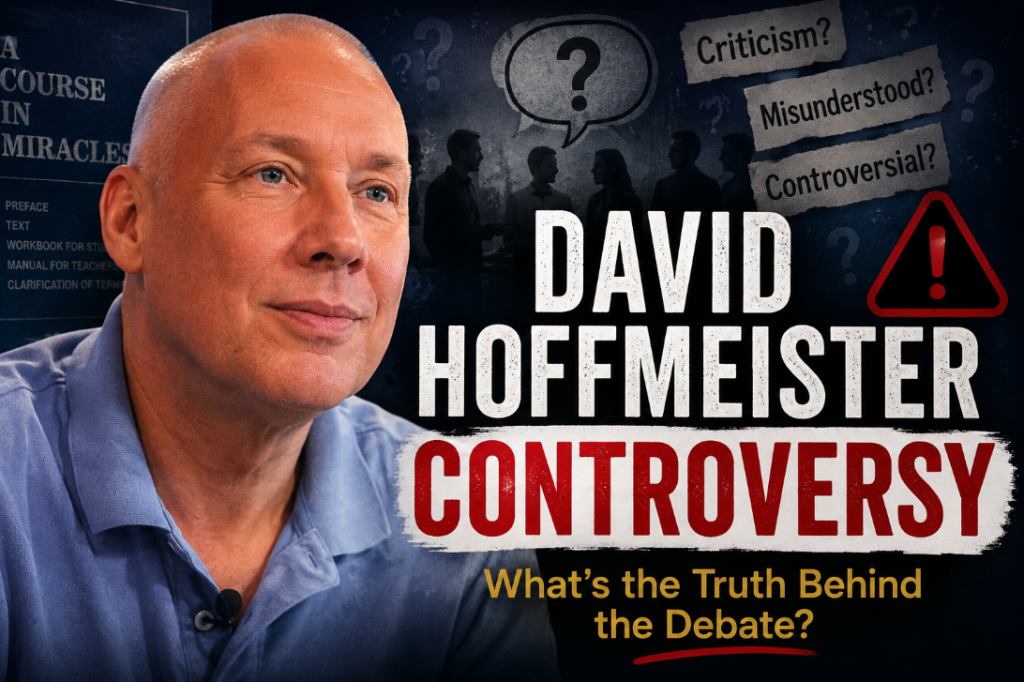
The topic david hoffmeister controversy appears frequently in online discussions where users interpret spiritual teachings through personal experience, belief systems, and repeated exposure to similar ideas. David Hoffmeister is associated with A Course in Miracles (ACIM) and teaches concepts based on perception, forgiveness, and non-dual awareness.
In most contexts, the term “controversy” does not indicate any verified factual issue. Instead, it reflects how perception psychology and belief reinforcement loops shape collective understanding in online environments.
📊 Perception Psychology Framework
| Factor | Influence on Understanding |
|---|---|
| Prior beliefs | Filters interpretation |
| Repeated exposure | Strengthens perception |
| Emotional response | Shapes acceptance |
| Social validation | Reinforces views |
| Online interaction | Amplifies opinions |
🧠 How Perception Psychology Works
1. Cognitive Filtering
People do not process information neutrally. They:
- compare it with existing beliefs
- accept what aligns with them
- question what conflicts with them
2. Emotional Interpretation
Emotions strongly influence understanding:
- calmness increases acceptance
- confusion increases doubt
- curiosity increases engagement
3. Selective Attention
Users focus on:
- ideas they relate to
- statements that stand out
- emotionally charged content
🌐 Belief Reinforcement Loops in Online Spaces
Online platforms create repetitive cycles of belief reinforcement.
1. Exposure Loop
Users repeatedly see similar interpretations:
- posts
- comments
- discussions
2. Validation Loop
When others agree:
- belief becomes stronger
- interpretation feels “confirmed”
3. Amplification Loop
Popular opinions get more visibility:
- repeated more often
- seen by more users
- influence grows over time
📌 Why “Controversy” Appears in This Context
The keyword david hoffmeister controversy appears mainly due to:
1. Repeated Interpretations
Different users repeat similar viewpoints, shaping perception.
2. Emotional Discussion Patterns
Strong opinions spread faster than neutral explanations.
3. Feedback Loops
Communities reinforce existing narratives.
🧩 Supportive Interpretation Pattern
Some users respond positively because:
- repeated exposure builds familiarity
- teachings feel emotionally meaningful
- perception shift feels useful
- ideas align with personal beliefs
📌 Critical or Neutral Interpretation Pattern
Other users respond differently:
- repeated skepticism reinforces doubt
- abstract ideas feel unclear
- lack of direct proof reduces acceptance
- different worldview creates resistance
📊 Perception Loop Table
| Loop Type | Effect |
|---|---|
| Exposure loop | Familiarity increase |
| Validation loop | Belief strengthening |
| Amplification loop | Opinion dominance |
🌍 Role of Online Platforms
Digital communities influence perception through:
1. Algorithmic Visibility
Popular opinions appear more frequently.
2. Engagement-Based Ranking
Emotional content spreads faster.
3. Community Reinforcement
Groups develop shared interpretations.
🧠 Key Analytical Insight
Perception of teachings is not fixed. It evolves through:
- repeated exposure
- social reinforcement
- emotional engagement
- cognitive filtering
This creates a dynamic belief system rather than a static understanding.
📌 Important Understanding
In most discussions, David Hoffmeister’s teachings are interpreted as:
- philosophical concepts
- experiential frameworks
- perception-based ideas
rather than universally agreed doctrines.
❓ FAQ
1. Why do opinions become stronger over time?
Because of repetition and social validation.
2. Do online platforms influence belief formation?
Yes, through visibility and engagement patterns.
3. Why do users interpret differently?
Due to cognitive and emotional differences.
4. What is a reinforcement loop?
A cycle where repeated exposure strengthens belief.
5. Is there real controversy involved?
No verified factual controversy exists.
